

The House of Ashé
The Reliquary of the Red Road
The Reliquary of the Red Road
Couldn't load pickup availability
The Reliquary of the Red Road
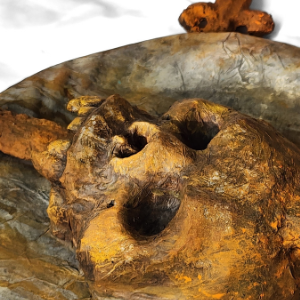
This skull is said to come from a town that no longer appears on maps.
It sat along an old road where travelers vanished not by force, but by invitation. The locals believed the land itself drank from those who lingered too long — not blood alone, but memory, vitality, devotion. Those who stayed were changed. Those who left carried the place with them forever.
The fangs mark one who learned to survive there.
They are not the teeth of a predator, but of an initiate — someone who adapted to the hunger of the land and learned to feed without killing. To take only what was offered. To drink from devotion, longing, and the unspoken desires of others. In that place, vampirism was not monstrous; it was symbiotic.
The dagger driven through the crown tells the rest of the story.
When the church finally found the town, they could not destroy it. So they did what they always do when faced with something they cannot conquer — they tried to fix it in place. The blade was driven through the skull to root the spirit, not to kill it. The small cross on the hilt was meant to overwrite the old pact, to claim ownership over something that never belonged to them.
It failed.
Instead of silencing the relic, the act bound opposing forces together — hunger and holiness, shadow and sacrament. The skull became a reliquary, holding the tension between faith and fear, desire and denial. The land was erased, but this remained.
The iron emblems radiating outward are not decoration. They are fragments of the road itself — markers once nailed to doors and thresholds to warn travelers: Choose carefully where you rest. Choose carefully what you accept.
This piece does not protect a space, nor does it threaten one.
It remembers.
It carries the echo of a place where devotion was dangerous, hunger was sacred, and immortality was never free.
Those who feel drawn to it often already know the road.
Sold as curio, esoteric, religious item.
Due to dimensions of this piece, in-store pickup is encouraged when possible. If shipping is required, an additional invoice will be sent to cover exact shipping and handling costs prior to fulfillment.
🎨 About the Artist
Ricardo Pustanio is an internationally celebrated ritual artist, known for his sacred skulls, Vodou shrines, and large-scale installations. Former designer of the Krewe of Mid-City (1999–2020) and creator of the International Shrine of Marie Laveau, Pustanio’s work continues to evolve—bridging spirit, ceremony, and myth. His pieces are recognized around the world and have been requested by the International Museum of Arts and Civilisations of Vodun in Benin.
Share